
Some beliefs don’t feel like opinions. They feel like facts.
“I’m not good under pressure.”
“I always mess things up.”
“If I slow down, everything will fall apart.”
When beliefs feel this solid, trying to replace them with positive thinking often backfires. The mind pushes back. The body tightens. Stress increases. The belief digs in deeper.
The problem isn’t that you’re resistant to change. The problem is that many beliefs are not held lightly. They are structural. They exist to create predictability and safety, especially in moments of uncertainty. The table leg method offers a way to work with these beliefs without attacking them, arguing with them, or shaming yourself for having them in the first place.
Why Some Beliefs Feel So Hard to Change
Stress-based or stress-fueled beliefs usually form for a reason. They develop during moments when the nervous system is under pressure and trying to make sense of what’s happening quickly. A conclusion gets drawn. A rule gets formed. Over time, that rule starts to feel permanent.
When stress is high, the brain prefers certainty – even painful certainty – over ambiguity. A belief like “I’m bad at this” may hurt, but it offers an explanation. It creates a sense of order. And once a belief has helped the system feel oriented, it tends to stick.
This is why directly asking “Is this belief true?” often doesn’t work. The nervous system hears that question as a threat. Defensiveness increases. The belief feels even more convincing.
The table leg method approaches belief change from a different direction.
What the Table Leg Method Is
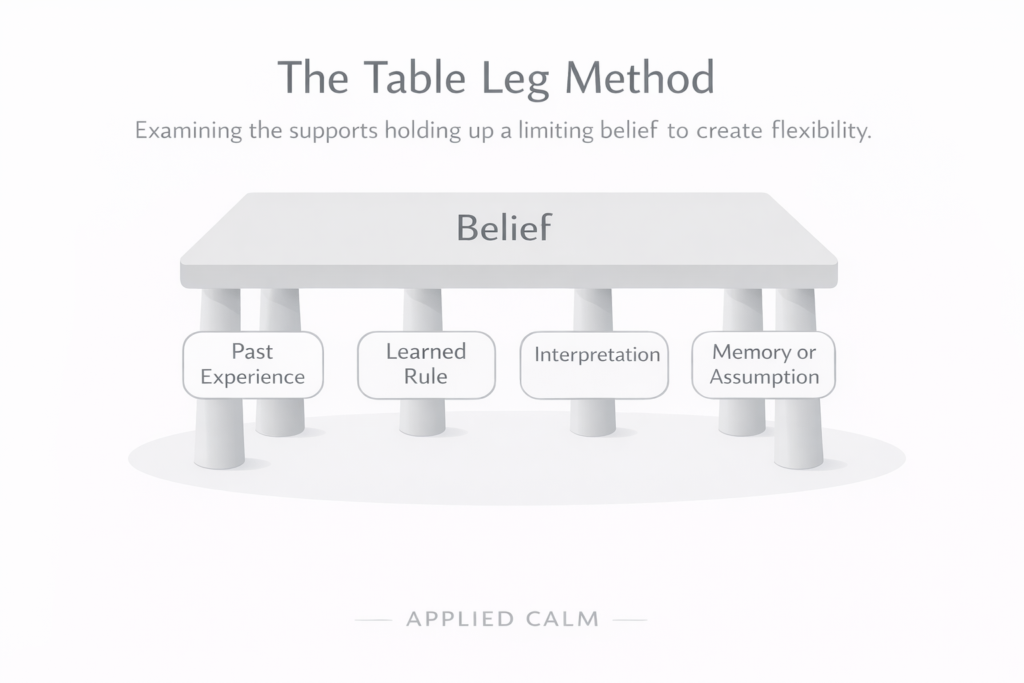
The table leg method uses a simple metaphor to explain why beliefs feel stable – and how they can become more flexible.
Imagine a belief as a tabletop. The tabletop feels solid because it’s being held up by several legs. Each leg represents a piece of “evidence” supporting the belief. That evidence might be a past experience, a memory, an interpretation, a learned rule, or something someone once said.
As long as all the legs are in place, the belief feels sturdy. It doesn’t matter whether the belief is helpful or harmful – it feels true because it is supported.
The goal of the table leg method is not to flip the table, or smash it apart. Instead, the goal is to gently examine the legs, one at a time, and notice what they’re actually made of.
What Counts as a “Table Leg”
The legs holding up a belief are often subtle. They may include things like:
- A specific past experience that left a strong emotional impression
- A pattern noticed during a stressful or transitional period
- An interpretation made quickly under pressure
- A rule learned from family, culture, or authority figures
- An assumption about what a single event means about you
Individually, each leg often makes sense. That’s important. The table leg method is not about proving that you were wrong to form the belief. It’s about recognizing how the belief became supported over time.
How the Method Works (Without Arguing with Yourself)
Instead of debating the belief itself, the table leg method invites curiosity about its supports. Rather than asking:
- “Why do I always think this way?”
- “Why can’t I get over this?”
- “Why am I so negative?”
You gently explore:
- “What experiences am I using as evidence for this belief?”
- “When did this belief first start to feel true?”
- “Are all of these supports equally strong?”
- “Are any of them outdated, incomplete, or based on interpretation rather than fact?”
You are not required to disprove the belief. Even noticing that one leg came from a single moment, a high-stress period, or someone else’s opinion can introduce flexibility. And flexibility is the goal – not immediate replacement.
A Simple Example
Belief: “I always mess things up.”
Possible table legs might include a visible mistake that felt humiliating, a critical comment from someone important, a pattern noticed during a particularly overwhelming time, or a rule learned early on that mistakes equal failure.
None of these legs are “stupid” or irrational. They make sense in context. But when you look at them individually, you may notice that some are old, some are situational, and some are interpretations rather than objective facts.
You don’t have to decide what to believe instead. The moment the belief stops feeling absolute, the nervous system has more room to breathe.
Why This Method Reduces Stress Instead of Increasing It
Many belief-challenging technique increase stress, because they create an internal fight. One part of the mind tries to force change, while another part defends what feels familiar and protective.
The table leg method avoids this by respecting the belief’s original purpose. It communicates to the nervous system:
- “I understand why this belief exists.”
- “I’m not trying to take away your sense of safety.”
- “We’re just looking more closely.”
Because the approach is non-threatening, the body stays more regulated. And when the nervous system is regulated, beliefs naturally become more flexible.
Belief Flexibility vs. Belief Replacement
Applied Calm focuses on flexibility, not forced positivity.
You do not need to replace a belief with its opposite. You do not need to convince yourself that everything is fine. You only need enough openness for alternatives to become possible.
When a belief loses one or two of its supporting legs, it no longer feels like the only explanation available. Other perspectives can coexist. Choice returns. Stress-based beliefs are often framed as personal flaws: I’m not resilient enough. I can’t handle pressure. I should be better at this.
The table leg method helps separate identity from experience. It reveals that many of these beliefs were build during moments of overload, not as permanent truths. This matters, because stress does not require fixing who you are. It requires understanding how your system has learned to respond.
A Closing Reframe
Beliefs are not failures of logic.
They are structures built for safety.
The table leg method does not ask you to tear those structures down. It simply invites you to look underneath them with curiosity and care.
And often, that’s enough to loosen what once felt unmovable.
