
Many of the experiences people struggle with most – stress, anxiety, overwhelm, reactivity, exhaustion, difficulty focusing or resting – are often treated as personal shortcomings. We assume that we should be able to “handle things better,” calm down faster, or think our way out of discomfort. When that doesn’t work, frustration and self-judgment tend to follow.
What’s often missing from these conversations is an understanding of the nervous system.
The nervous system is not just a background biological feature. It is the system that determines how safe you feel in the world, how quickly you react, how easily you rest, an dhow much flexibility you have in responding to life. When you understand how it works, many reactions that once felt confusing or shameful begin to feel logical – even predictable.
And when something makes sense, it becomes workable.
What the Nervous System is Designed to Do
At its most basic level, the nervous system exists to keep you alive. Its primary concern is not happiness, productivity, or emotional insight – it is safety. Every moment, it is scanning both your internal state and your external environment for cues that answer one central question: “Am I safe right now?”
This scanning happens largely outside of conscious awareness. Long before your thinking mind has time to interpret a situation, your nervous system has already begun adjusting heart rate, breathing, muscle tone, digestion, attention, and emotional state. This is why reactions often feel instantaneous and automatic. The system evolved to prioritize speed over reflection.
Importantly, the nervous system does not distinguish well between physical danger and psychological or emotional threat. A loud noise, an approaching deadline, unresolved conflict, financial uncertainty, or social evaluation can all activate the same internal machinery. From the nervous system’s perspective, urgency is urgency.
This does not mean your body is overreacting. It means it is responding with the tools it has.
The Autonomic Nervous System: Automatic and Protective
Much of what shapes stress and regulation happens within the autonomic nervous system, the part of the nervous system that functions automatically. You do not consciously decide when to increase your heart rate, tighten your muscles, or shift your breathing pattern. These changes happen reflexively in response to perceived conditions.
The autonomic nervous system has two primary branches that work together to support survival and recovery: the sympathetic nervous system (SNS) and the parasympathetic nervous system (PNS). These systems are not opposites in conflict. They are complementary, designed to help you meet different kinds of demands.
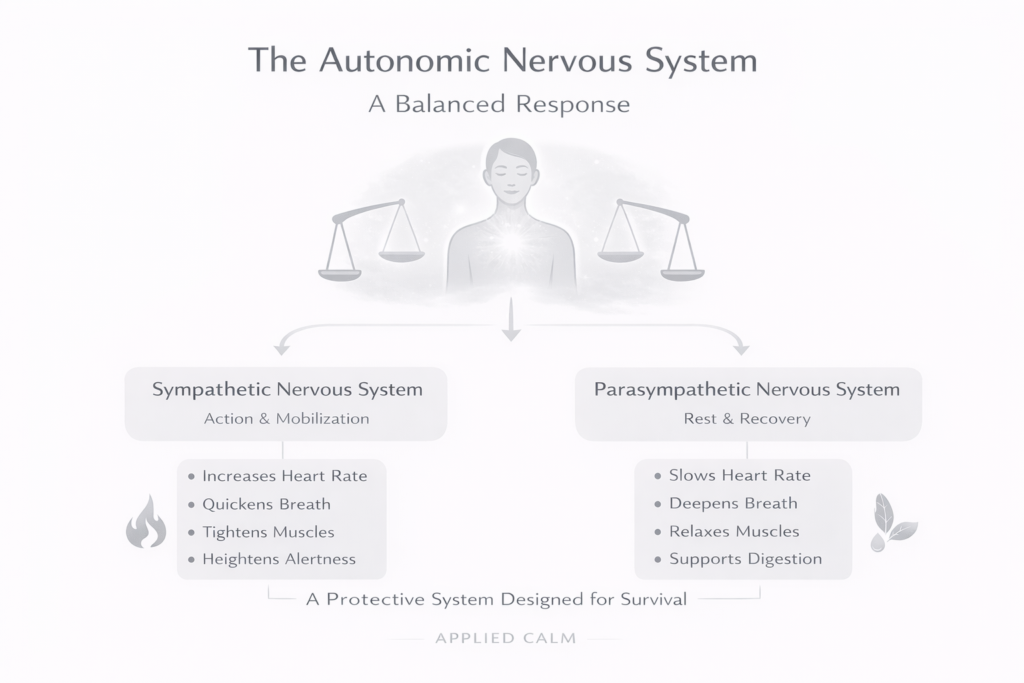
The Sympathetic Nervous System: Mobilization and Action
The sympathetic nervous system is often associated with the “fight or flight” response. When this system is activated, the body prepares for action. Heart rate increases, breathing becomes faster and shallower, muscles tense, and attention narrows toward potential threat or demand. Energy is mobilized. Non-essential processes, like digestion and deep rest, are temporarily deprioritized.
This state is not inherently negative. The sympathetic nervous system allows you to focus, react quickly, meet challenges, and perform under pressure. It supports motivation, alertness, and engagement with the world. Without it, you wouldn’t be able to respond effectively to many everyday situations.
Problems arise not because the sympathetic nervous system exists, but because it can become overused. In modern life, many stressors are ongoing, abstract, or unresolved. The system is activated repeatedly without sufficient recovery. Over time, this can lead to chronic tension, fatigue, irritability, sleep disruption, and a persistent sense of urgency.
When people describe feeling “wired but tired,” they are often experiencing a nervous system that has spent too much time in sympathetic activation without adequate opportunities to settle.
The Parasympathetic Nervous System: Rest, Repair, and Regulation
The parasympathetic nervous system supports the opposite side of the survival equation: rest, recovery, digestion, and connection. When this system is active, heart rate slows, breathing deepens, muscles soften, and the body shifts toward repair and restoration. Attention broadens. The nervous system receives the message that it is safe enough to rest.
The parasympathetic system is sometimes described as the “rest and digest” system, but its role goes beyond physical recovery. It also supports emotional regulation, social engagement, and the ability to feel grounded and present. This is the state in which learning, healing, and integration are most likely to occur.
Importantly, parasympathetic activation is not something you can force through willpower. The nervous system does not respond to commands. It responds to cues—slower breathing, gentle movement, physical safety, predictable rhythm, and compassionate attention.
When people struggle to relax, it is rarely because they are doing something wrong. It is often because their nervous system has not yet received enough signals that it is safe to do so.
Why Your Body Often Reacts Before You Think
One of the most important things to understand about the nervous system is that it operates faster than conscious thought. This is why you might feel anxious, tense, or shut down before you’ve had time to logically assess a situation. The response is not a failure of reasoning—it is a feature of survival biology.
This is also why purely cognitive strategies often fall short when stress is high. Telling yourself to calm down, think positively, or “just relax” rarely works if the nervous system is already activated. Regulation does not begin with convincing the mind. It begins with signaling safety to the body.
Once the nervous system settles, the mind becomes more flexible. Perspective returns. Options expand. Thought follows state.
Stress Is a State, Not a Personal Identity
One of the most powerful reframes in nervous system education is recognizing that stress is a state, not a trait. Feeling anxious, overwhelmed, reactive, or exhausted does not mean that you are weak, broken, or incapable. It means your nervous system is responding to perceived demand with the patterns it has learned.
These patterns are shaped over time by experience, environment, expectations, and previous stress. They are adaptive responses, not moral failures. When stress becomes chronic, it is often because the system has learned that staying alert is safer than standing down.
Understanding this removes blame from the equation. Instead of asking, “What’s wrong with me?” the question becomes, “What has my nervous system learned, and what does it need now?”
Regulation is About Flexibility, Not Control
In Applied Calm, regulation is not about forcing yourself into calm or eliminating stress altogether. A regulated nervous system is not always relaxed. It is flexible. It can activate when needed and settle when activation is no longer required.
True regulation means the system can move between sympathetic and parasympathetic states without getting stuck. It means stress responses can resolve, rather than linger. This flexibility is what allows people to feel resilient—not because they never experience stress, but because their system can recover from it.
Practices that support regulation work with the nervous system’s language. They emphasize rhythm, awareness, physical sensation, and gentle shifts rather than pressure or performance.
Why Learning This Changes Everything
For many people, learning about the nervous system brings a deep sense of relief. Experiences that once felt like personal flaws begin to feel understandable. Reactivity becomes contextual. Fatigue becomes explainable. Difficulty relaxing stops feeling like failure.
Understanding your nervous system does not mean you will never feel stressed again. It means you gain context, language, and choice. You learn how to listen to your body instead of fighting it. From that place, meaningful change becomes possible.
A Grounded Takeaway
Your nervous system is not working against you.
It is not broken.
And it does not need to be fixed.
It is a protective system shaped by experience and capable of learning new patterns when given the right conditions.
Applied Calm exists to help create those conditions—through education, awareness, and practical tools that respect both biology and humanity.
Understanding your nervous system is not about mastering yourself.
It’s about learning how to respond with curiosity, compassion, and care.
