
What Stress Actually Is
Stress has become one of the most misunderstood experiences of modern life. We often treat it as something to eliminate, suppress, or push through, and when it lingers, we turn it inward as evidence that we’re not coping well enough. Over time, stress stops feeling like a response and starts feeling like a verdict on our character.
In reality, stress is not a flaw or a failure. It is a biological process designed to help human beings respond to perceived demands, threats, or challenges. Stress is not the event itself, but the body’s internal reaction to what the brain believes is urgent or important. Long before modern responsibilities existed, this response allowed humans to react quickly, mobilize energy, and survive danger. Stress was never designed to make us calm—it was designed to make us effective.
The difficulty today is not that the stress response exists, but that modern life activates it constantly, often without resolution.
Stressors vs. Stress
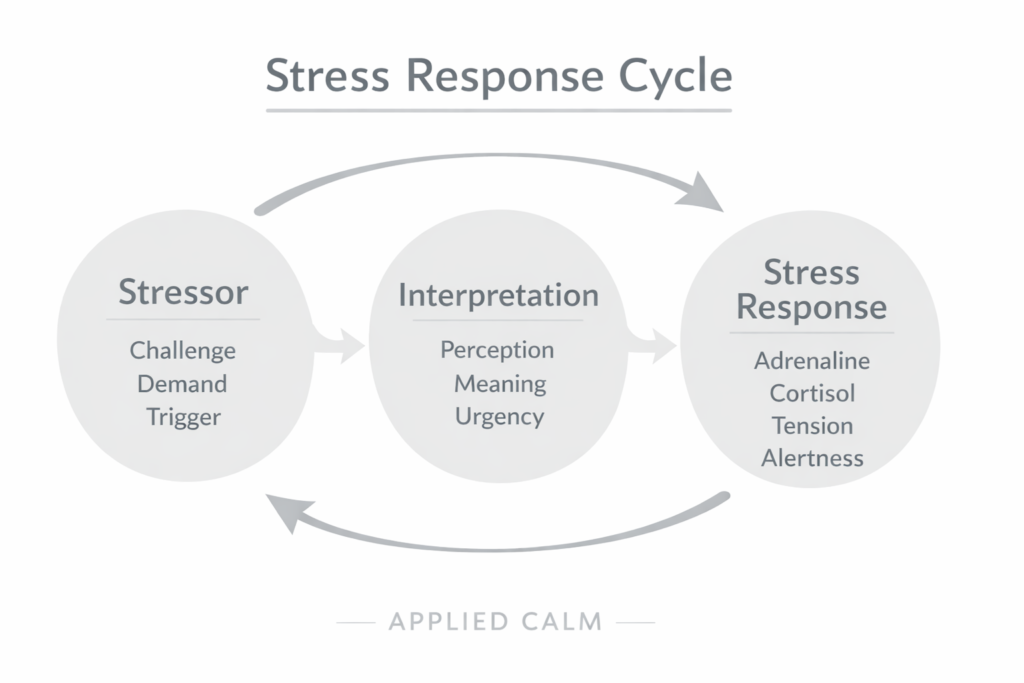
A crucial shift in understanding stress comes from separating stressors from stress itself. Stressors are the external circumstances we encounter—deadlines, conflicts, uncertainty, responsibility. Stress is the physiological response that follows. Two people can experience the same stressor and have very different internal reactions because stress is shaped not just by what happens, but by how the brain interprets meaning, urgency, and threat.
This interpretation is influenced by past experience, nervous system conditioning, fatigue, beliefs, and context. Stress, therefore, is not a direct measure of reality or strength. It is a reflection of how the nervous system has learned to respond.
What Happens in the Body During Stress
When the brain perceives a threat or demand, it activates a rapid and automatic survival response. This includes several coordinated changes in the body:
- Adrenaline increases heart rate and blood pressure to deliver oxygen quickly
- Cortisol mobilizes energy and sharpens attention
- Breathing becomes faster and shallower
- Muscles tense in preparation for action
- Digestion and long-term maintenance processes slow
None of these changes are mistakes. They are the body prioritizing immediate survival. Your nervous system is not overreacting—it is responding based on perceived urgency.
Why Stress Becomes Chronic
The stress response was designed for short bursts followed by recovery. A danger appears, the body mobilizes, the danger passes, and the system resets. Modern stressors rarely follow this pattern. Many are ongoing, abstract, or future-oriented, with no clear endpoint or physical release.
As a result, the stress response remains partially or fully activated for long periods of time. The body stays in a state of readiness even when no immediate action is required. This chronic activation is exhausting, not because you are weak, but because the system was never designed to run continuously.
Why Stress Feels Like a Personal Failure
When stress persists, it is easy to internalize it as something being wrong with you. We live in a culture that often equates calm with competence and composure with success. When we feel overwhelmed, tense, or anxious, we assume others are handling things better and that we should be able to do the same.
But stress is not a moral failing. In fact, people who are conscientious, thoughtful, empathetic, and responsible often experience more stress because their nervous systems are highly attuned to impact and consequence. Stress does not mean you are incapable—it often means you care.
Interrupting the Stressor–Stress Response Loop
Reducing stress does not require eliminating stressors from your life. It requires learning where and how to interrupt the automatic loop between stressor and response. There are several leverage points where this can happen:
- Early awareness, noticing physical and mental signs of stress before they escalate
- Regulating the body, using slower breathing, grounding, and muscle release to signal safety
- Reframing meaning, shifting from danger-based interpretations to realistic, non-catastrophic ones
These interventions are not about forcing calm or denying reality. They are about teaching the nervous system that urgency does not always equal threat.
Why Stress Is Not a Flaw to Fix
Trying to control or suppress stress often increases it, because resistance itself signals danger to the nervous system. A more effective approach is understanding and compassion. When stress is recognized as a protective response rather than a personal failure, the internal struggle softens.
Stress is not evidence that you are broken. It is evidence that your nervous system is doing what it learned to do in the presence of perceived demand. That system can be retrained—not through pressure or shame, but through awareness, regulation, and practice.
An Empowering Reframe
Stress is not your enemy. Your body is not betraying you. And you are not failing.
Stress is information. It is a signal that something matters. When you stop treating it as a flaw and start understanding it as a system, you regain the ability to work with it instead of against it.
And that is where real, lasting change begins.
