
For many people, saying “no” doesn’t feel simple or empowering. It feels uncomfortable, guilt-inducing, or even frightening. We hesitate. We explain. We soften. We overextend. And often, we say “yes” while feeling depleted, resentful, or quietly overwhelmed.
What’s rarely acknowledged is that difficulty saying no is not a personal weakness or a communication problem. It’s a learned response – one shaped over time by stress, conditioning, and the nervous system’s deep need for safety, belonging, and approval.
At Applied Calm, we approach boundaries not as personality traits or productivity tools, but as physiological and psychological skills. Saying no is not just a social decision. It’s a nervous-system decision.
And for many adults, it is a skill that was never modeled, supported, or made to feel safe.
Why “No” Feels So Hard for So Many People
As children, “no” often emerges as a powerful word. It marks the beginning of autonomy, identity, and self-definition. It is how children test limits, express needs, and discover where they end and others begin.
But over time, many people receive subtle – or explicit – messages that saying no has consequences. It may lead to disappointment, conflict, withdrawal of affection, or judgment. The nervous system pays close attention to these moments.
Gradually, “yes” becomes associated with safety. Approval. Belonging. Predictability.
By adulthood, this conditioning often shows up as chronic overcommitment. We say yes when we are already exhausted. Yes when we are overwhelmed. Yes when something goes against our values. Yes when our body is quietly asking for rest.
And almost always, it’s the most important things – health, relationships, time alone, creative space, recovery – that are first to be sacrificed.
This is not because we don’t value ourselves. It is because our system has learned that prioritizing others feels safer than prioritizing ourselves.
The Hidden Cost of Always Saying Yes
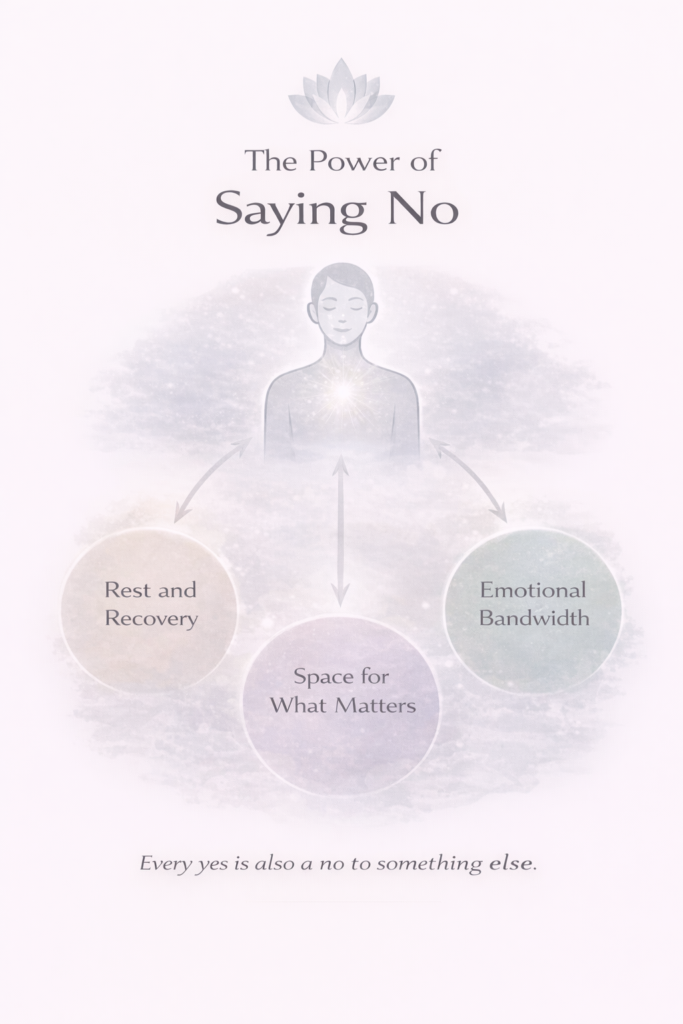
Every yes carries a cost, whether we consciously acknowledge it or not. When we agree to something, we are not only giving time or energy – we are also withholding that time and energy from something else.
Often, that trade-off happens quietly and accumulates slowly:
- Less time to rest or recover
- Less emotional availability for relationships that matter
- Less space for reflection, creativity, or health
- A growing undercurrent of resentment, fatigue, or numbness
From a nervous system perspective, chronic over-giving keeps the body in a state of ongoing mobilization. There is always another demand to meet, another expectation to manage, another role to fulfill.
The system never fully stands down.
Stress builds not because life is inherently too demanding, but because the body never received permission to stop responding.
The “Yes” Trap: What We Get from Saying Yes
One of the most important things to realize is that people don’t say yes “for no reason.” There are often real and meaningful benefits – especially in the short term.
Saying yes can help us feel:
- Needed or valued
- Reliable or dependable
- Kind, generous, or supportive
- Competent or indispensable
It can protect us from conflict. It can preserve relationships. It can reinforce an identity that feels familiar and safe. In some cases, it simply feels easier than tolerating the discomfort of saying no.
Understanding this matters deeply, because it removes shame from the conversation. If saying yes has helped you feel secure, connected, or worthy in the past, your nervous system is not wrong for using it.
The question becomes not “Why do I keep doing this?” but rather, “What has this been helping me survive?”
Why Saying No Triggers Guilt and Fear
For many people, guilt appears almost immediately after saying no. This guilt can feel heavy, personal, and moral. But often, it’s not true guilt – the kind that signals harm done or repair needed.
Instead, it is frequently a sign that:
- A familiar role is being challenged
- An old pattern is shifting
- The nervous system is leaving known territory
The body interprets this change as risk. Thoughts arise quickly: What will they think of me? Will I disappoint them? Will I lose something important?
This reaction does not mean the boundary is wrong. It often means the boundary is new.
At Applied Calm, we treat guilt not as a warning to retreat, but as information: something meaningful is changing, and the nervous system is adjusting.
Boundaries Begin with Knowing What Matters
One reason saying no feels so destabilizing is that many people are not deeply connected to their own priorities. When you don’t know what you’re protecting, it becomes harder to protect it.
Clarity changes everything.
When you know what matters most – your health, your time, your relationships, your energy – no becomes less about rejection and more about alignment. You are no longer denying someone else. You are choosing something that matters to you.
And that distinction matters profoundly to the nervous system.
Boundaries rooted in clarity feel steadier than boundaries rooted in guilt or obligation.
Saying No as a Nervous System Skill
From a physiological perspective, boundaries are acts of regulation. Each time you say no in a way that honors your capacity, you send your nervous system a powerful message: I am allowed to take care of myself.
Over time, this builds internal trust.
Saying no does not need to be dramatic or confrontational. It can be simple, truthful, and calm. It can be temporary. It can be conditional. It can be firm without being harsh.
What matters most is not the exact wording, but the congruence – the alignment between what you say and what your body actually needs.
When words and internal experience match, the nervous system settles.
Why Practice Matters
For people who have long been identified – by themselves or others – as “the yes person,” change can feel destabilizing. Not just socially, but internally.
This is why gradual change is often more sustainable than sudden shifts. Practicing small, low-stakes no’s allows the nervous system to learn that boundaries do not automatically lead to danger, rejection, or loss.
Each experience of saying no and surviving it – emotionally, relationally, socially – builds capacity. The system learns through experience, not logic.
Over time, the body begins to trust: I can choose myself and still be okay.
A Reframe: No Is Not a Withdrawal
Saying no is not selfish.
It is not a lack of generosity.
It is not a failure of kindness.
No is a boundary that protects what matters.
It creates space for rest, presence, authenticity, and health. It allows yes to become intentional rather than automatic – chosen rather than coerced.
And perhaps most importantly, it restores agency.
The Power of No, Reclaimed
You do not owe access to your time, energy, or capacity simply because someone asks. You are allowed to pause. You are allowed to consider. You are allowed to choose.
Learning to say no is not about becoming rigid or unavailable. It is about becoming intentional and aligned.
And intentionality – especially when rooted in self-respect – is one of the most powerful forms of calm there is.
Note: If you’re looking for additional help setting boundaries and saying no, why not try our “The Power of Saying No” workbook? It’s completely free, and you can download it directly here:
