
Breathing exercises are often offered as simple solutions to complex problems. When stress rises, when anxiety flares, when sleep feels elusive, the advice arrives quickly: just breathe. For some people, that advice feels grounding. For others, it feels dismissive, confusing, or ineffective. Many try breathing exercises earnestly, only to conclude that they must be doing something wrong when relief doesn’t arrive.
What’s rarely explained is that breathing exercises are not a single intervention. They are a category of tools, each designed to influence the nervous system in a specific way. They are not interchangeable, and they are not meant to produce the same internal state.
At Applied Calm, breathing exercises are understood as regulation tools, not fixes. They don’t remove stressors or resolve emotional complexity. What they can do is gently alter physiological signals that shape how stress is experienced in the body. When used thoughtfully, they can create just enough space for clarity, choice, and recovery to become possible.
To use breathing practices well, it helps to understand what each one is actually designed to do.
Why the Breath Has So Much Influence
Breathing occupies a unique position in human physiology. It is automatic — the body breathes whether you think about it or not — but it is also voluntarily adjustable. You can slow it, deepen it, pause it, or change its rhythm. That makes it one of the most accessible ways to communicate with the nervous system.
Changes in breathing patterns influence heart rate variability, blood chemistry, vagal nerve signaling, and overall arousal. Slow, intentional breathing tends to increase predictability and coherence in these systems, which the brain often interprets as safety.
But “slow” is not enough information on its own. The structure of the breath — whether it is symmetrical or asymmetrical, whether it includes holds, whether the exhale is emphasized — determines the effect.
This is where many well-intentioned breathing practices fall short. People are taught techniques without context, and then expected to apply them universally. When the technique doesn’t match the nervous system’s current state, it can feel uncomfortable or ineffective.
Understanding purpose matters.
Breathing for Stabilization: Box Breathing
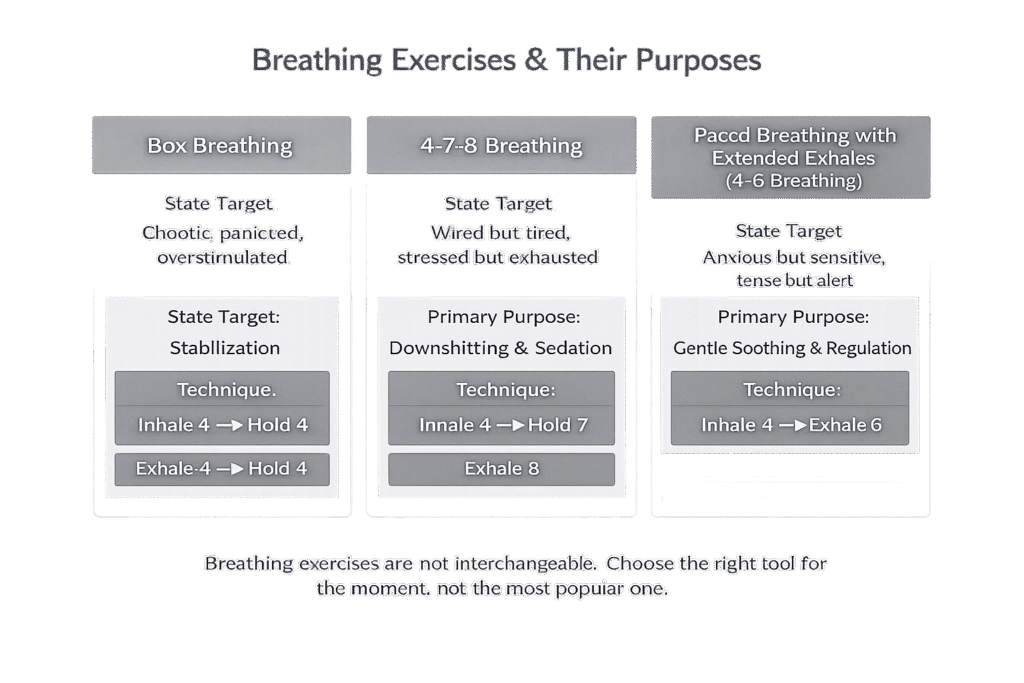
Box breathing follows a simple, symmetrical pattern: inhale for four counts, hold for four, exhale for four, hold for four. This structure is not accidental. Symmetry is calming to the nervous system because it creates predictability and rhythm without pushing the system toward sleep or collapse.
Box breathing is designed primarily for stabilization. It helps regulate erratic breathing patterns, interrupts panic spirals, and restores a sense of control when emotions or thoughts feel overwhelming. This is why it’s often taught in high-pressure contexts — military training, emergency response, performance settings — where calm is needed without loss of alertness.
What box breathing offers is containment. The brief breath holds engage attention and give the mind something concrete to track. For people who feel scattered, flooded, or “amped up,” this can be grounding in a way that purely slow breathing sometimes isn’t.
Importantly, box breathing is not meant to deeply relax you. It’s meant to help you regain footing. Many people report feeling clearer, steadier, and more present after a few cycles, rather than sleepy or heavy.
This also explains when box breathing may not be ideal. If someone is already exhausted, emotionally flat, or trying to wind down at night, the structure and effort of box breathing can feel like too much. In those moments, the nervous system may not need containment — it may need release.
Breathing for Downshifting: 4-7-8 Breathing
4-7-8 breathing introduces asymmetry into the breath cycle: a shorter inhale, a long breath hold, and an even longer exhale. This asymmetry is what shifts the nervous system toward parasympathetic dominance — the branch associated with rest, digestion, and sleep.
The long exhale is the most influential element. Extended exhalation stimulates the vagus nerve and encourages heart rate slowing. The breath hold increases carbon dioxide tolerance, which can reduce the drive to over-breathe — a common feature of anxiety.
Unlike box breathing, 4-7-8 breathing is not about stabilization. It is about downshifting. Its purpose is to help the system let go of vigilance and move toward rest.
This is why it’s most useful in the evening, before sleep, or after prolonged periods of stress when the body feels wired but depleted. Many people describe it as sedating or heavy, sometimes noticing a sense of warmth, slowing, or drowsiness.
That sedating quality is also why it’s not appropriate for every moment. Using 4-7-8 breathing when you need to stay alert — before a meeting, while driving, or during emotionally charged conversations — can leave you feeling foggy rather than regulated.
It’s also important to acknowledge that the long breath hold can feel uncomfortable for some people, especially those with anxiety sensitivity or trauma histories. This doesn’t mean the practice is harmful, but it does mean it may not be the right starting point. Nervous systems that are already hypervigilant often respond better to gentler, less intrusive rhythms.
Breathing for Gentle Regulation: Paced Breathing with Extended Exhale (4-6 Breathing)
One of the most widely used — and often under-explained — breathing approaches is paced breathing with a slightly longer exhale than inhale, such as inhaling for four counts and exhaling for six. Unlike box breathing or 4-7-8 breathing, this pattern usually includes no breath holds.
This simplicity is its strength.
By emphasizing a longer exhale without adding pauses, paced breathing offers a gentle signal of safety that many nervous systems tolerate well. It encourages parasympathetic activation without pushing the system toward sedation or demanding a high level of attentional control.
For many people, this is the most accessible entry point into breathing practice. It can be done discreetly, during the day, at work, or in social settings. It often feels natural rather than effortful, and its effects tend to accumulate subtly rather than dramatically.
This approach is especially helpful for individuals who find breath holds uncomfortable, or who become anxious when they feel they’re “doing” a technique incorrectly. The nervous system responds more to relative timing — longer exhales than inhales — than to exact numbers.
In many cases, this type of breathing becomes a foundational regulation tool that people return to repeatedly because it integrates easily into daily life.
Choosing the Right Tool for the Moment
One of the most common reasons breathing exercises fail is not because they don’t work, but because they’re used without regard for context. Different nervous system states call for different forms of support.
Rather than asking, Which breathing exercise is best? it’s often more helpful to ask:
What does my nervous system need right now?
Broadly speaking:
- When the system feels chaotic, panicked, or overstimulated, stabilization is often needed first.
- When the system feels wired but depleted, downshifting may be appropriate.
- When the goal is steady calm without sedation, gentle regulation is often the most sustainable choice.
Breathing exercises are not about forcing calm. They are about offering the body a rhythm it can follow when its own rhythm has become strained.
A Grounded Reframe
Breathing exercises don’t work because they make problems disappear. They work because they change the conditions under which problems are experienced.
If a particular breathing practice doesn’t help — or makes you feel worse — that is not a failure. It’s information. It suggests that your nervous system may need a different kind of support in that moment.
When taught with context and choice, breathing exercises become reliable companions rather than pressure-filled prescriptions. They don’t promise instant relief. They offer regulation, pacing, and a small but meaningful shift in how the body responds to stress.
The breath doesn’t solve stress.
It supports the system that’s carrying it.
