
Emotional Freedom Technique (EFT), often called tapping, occupies an unusual place in the wellbeing world. Some people describe it as surprisingly effective. Others remain skeptical, uncomfortable with the language around it, or wary of how confidently it’s sometimes marketed online. Both responses are reasonable.
At Applied Calm, we’re less interested in convincing people to adopt a technique and more interested in helping them understand what something actually does, where it helps, and where it doesn’t. EFT deserves that kind of grounded, adult conversation.
So let’s slow this down and look at EFT clearly — without hype, dismissal, or exaggerated claims.
What EFT Actually Is (and What It Isn’t)
At its most basic level, EFT combines gentle physical tapping on specific points of the body with focused attention on an emotional experience. While its original framework borrowed from acupuncture meridians, many modern explanations focus instead on how rhythmic sensory input, attention, and language interact with the nervous system.
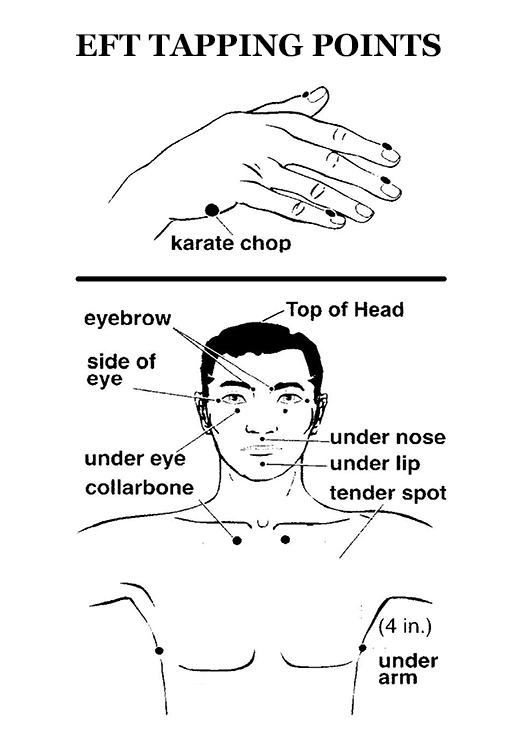
In practice, EFT involves acknowledging an emotional issue while tapping through a set sequence of points on the face, upper body, and hands. The goal isn’t to eliminate emotion or force calm, but to stay present with what’s happening in a way that reduces overwhelm.
It’s equally important to be clear about boundaries. EFT is not therapy. It does not diagnose or treat mental health conditions, and it is not a substitute for medical or psychological care. When those distinctions are blurred, EFT stops being supportive and starts becoming misleading.
Used responsibly, EFT is best understood as a self-regulation practice, not a treatment model.
How EFT Is Commonly Used in Real Life
Most people aren’t using EFT for dramatic breakthroughs or deep emotional excavation. They’re using it in everyday moments where their nervous system feels overloaded.
Common situations where people turn to EFT include:
- Moments of acute stress or emotional overwhelm
- Performance-related anxiety (presentations, tests, public speaking)
- Persistent worry, rumination, or emotional looping
- Emotional charge connected to memories or triggers
From an Applied Calm perspective, EFT functions primarily as a down-regulation tool. It gives the body something steady and repetitive to focus on while the mind acknowledges what’s happening instead of fighting it. For people who struggle with purely cognitive approaches, that physical element can make regulation feel more accessible.
What the Technique Looks Like in Practice
A typical EFT round begins with specificity. Instead of focusing on something broad like “my anxiety,” the person identifies a concrete experience, such as the tightness in their chest when thinking about an upcoming conversation.
That experience is then acknowledged directly, often with language that sounds like: “Even though I feel this tightness and anxiety, I accept myself right now.” This phrasing matters. It doesn’t deny discomfort, and it doesn’t demand change. It creates permission for the nervous system to soften rather than brace.
While gently tapping on a sequence of points — often including areas like the side of the hand, face, collarbone, and head — the person continues to name what they’re experiencing. As the body settles, the language may shift naturally toward neutrality, reassurance, or simply less intensity.
The combination of rhythmic touch, focused attention, and honest language can interrupt stress loops and help the body reorient to the present moment.
The Real Benefits of EFT
EFT’s benefits are practical, not miraculous. For many people, tapping reduces emotional intensity enough to make a situation feel manageable rather than overwhelming.
Some of the most realistic benefits people report include:
- A noticeable drop in emotional charge
- Increased awareness of bodily sensations
- A greater sense of steadiness during stress
- An easier time acknowledging emotions without spiraling
Another meaningful advantage is accessibility. EFT doesn’t require special equipment, a quiet room, or long training. That simplicity makes it usable in real life, not just ideal conditions.
EFT also pairs well with other regulation practices — breathwork, grounding, journaling, mindfulness, or coaching — rather than competing with them. When it works, it works as part of a broader calm toolkit.
The Limitations (This Is Where Integrity Matters)
EFT is often oversold, and that overselling is where harm can occur.
It is not a cure for trauma, anxiety disorders, chronic illness, or deeply entrenched psychological patterns. Claims that EFT can permanently “clear” complex emotional wounds are not supported and can create unrealistic expectations.
Responses to EFT vary widely. Some people feel relief quickly. Others feel little or nothing. Neither response reflects effort, openness, or doing it “correctly.”
It’s also important to recognize that focusing on emotionally charged material can sometimes surface more than expected. For people with unresolved trauma, tapping without adequate support can feel destabilizing rather than calming.
Finally, EFT should never be used to avoid appropriate professional care. Any approach that discourages therapy, medical treatment, or crisis support crosses an ethical line.
EFT Through an Applied Calm Lens
Applied Calm approaches EFT the same way it approaches all regulation tools: as optional, supportive, and bounded.
You don’t need to believe in any particular theory for EFT to be useful. You do need to remain connected to your body, honest about your experience, and respectful of your own limits. Calm is not something you force — it’s something that emerges when the nervous system feels safe enough to settle.
If EFT helps you slow down and soften activation, it may earn a place in your toolkit. If it doesn’t resonate, that’s not a failure — it’s information.
Learning EFT Without the Hype
If you want to explore EFT further, look for sources that emphasize training standards, ethics, and realistic expectations rather than miracle language.
Trustworthy starting points include EFT International, which maintains practitioner standards and research summaries, and the Association for Comprehensive Energy Psychology, which situates EFT within a broader research-informed framework. For integrative context, the National Institute for Integrative Health offers perspective on mind-body practices without overstatement.
As a general rule, be cautious of any EFT resource that promises instant transformation, discourages professional care, or frames skepticism as resistance.
A Grounded Takeaway
EFT isn’t magic. It isn’t meaningless either.
For some people, it’s a practical way to reduce emotional intensity and reconnect with the body during moments of stress. For others, it won’t land — and that’s okay.
Applied Calm isn’t about finding the perfect tool. It’s about offering humane, honest options that support regulation without pressure or illusion. EFT can be one of those options — when it stays in its lane.
